
Hyde Park Previous Resident Sources
A Hyde Park backward address search starts with the era. The present parcel card supplies the current legal anchor, but earlier ownership, household, building, and family records live in different collections. The table distinguishes a dated clue from proof of continuous residence. Start with the most recent reliable record, then move back one source at a time. For a record that is not online for the Hyde Park address, use the County Clerk Record Room, a DCHS research request or reading room, the town office, or the relevant court counter.
| Source | Years it covers | Where held | What it shows |
|---|---|---|---|
| County Clerk deeds | July 7, 1907 to present online | Dutchess County Clerk search and Record Room | Grantor, grantee, legal description, book or page, recording date |
| County Clerk mortgages | 1981 to present online | Dutchess County Clerk | Security and debt trail, not proof of occupancy |
| Dutchess directories | 1893–96, 1895–96, and 1901–05 named runs | DCHS | Address, name, and occupation clues where included |
| Poughkeepsie directories | 1871–72 through 1890–91, plus 1897 copies | DCHS | Regional trail; Hyde Park inclusion must be verified |
| Telephone directory | 1950–51 | DCHS locator | Phone and address clue, not a full population list |
| New York state censuses | 1855, 1865, 1875, 1892, 1905, 1915, 1925 collections | FamilySearch and DCHS | Periodic household evidence; schedules can be incomplete |
| Sanborn maps | 1913, republished 1950 and 1952 | Library of Congress | Building and block context, not an occupant name |
Previous residents of a Hyde Park address may appear in an owner record, a directory, a census, or a death-related source. Each label needs its own date and source.
Freeze Hyde Park Parcel Records
Before going backward, capture the current Hyde Park ParcelAccess record as a starting snapshot. Save the exact street spelling and number, parcel number, legal location, owner name, primary owner mailing address, deed book or page, filed-map link, and last sale data. The owner mailing address is a correspondence field, not a conclusion about where someone lives. The parcel number and legal description remain useful even when the street number changes or an early deed never used one.
ParcelAccess has separate parcel, sales, assessments, and filed-map modes. A full card may include parcel history, tax rolls, historical aerials, and a historic resource survey link. Keep the access date with your notes because tentative assessments are posted May 1 and final rolls July 1. The county says the card is neither a title search nor a survey.
Note: Recording the present parcel facts first prevents a later directory entry, map label, or similar name from being attached to the wrong Hyde Park property.
Trace Hyde Park Deed Records
The Dutchess County Clerk index is the main recorded-land route for Hyde Park past residents research. It supports party name, document type, year, document number, liber, page, municipality, party type, recorded date, comment, and complement name. Search the owner with Town of Hyde Park selected, choose a deed, and compare the legal description with the parcel record. Search spelling variants. The Clerk says the name search ignores capitalization, special characters, and spaces, but also warns that the results are not guaranteed accurate.
- Use the parcel card’s owner and deed book or page to find the current transfer in the Dutchess County Clerk Document Search.
- Read the image, not only the result line. Record each party’s role, recording date, document number, legal description, and any cited prior deed.
- Search the seller, or grantor, as a grantee in an earlier deed. Match lot, subdivision, acreage, adjoining owners, and prior reference before adding the transfer to the chain.
- Repeat the grantee-to-grantor step, preserving name variants and the page or liber information that belongs to each instrument.
- When the online period ends, bring the legal description and book clues to the County Clerk Record Room or the historical research route rather than guessing from a street number.
Deeds are online from July 7, 1907. Historic images cover deeds through December 31, 1988, while the modern set begins January 1, 1989. County Clerk materials identify historic images as accurate as of April 1, 2007. Images may be viewed online without charge; downloads or prints are $0.50 per page, and certified copies require a separate office transaction.
The County Clerk deed-index search is the source for the party, municipality, and recording filters described here.
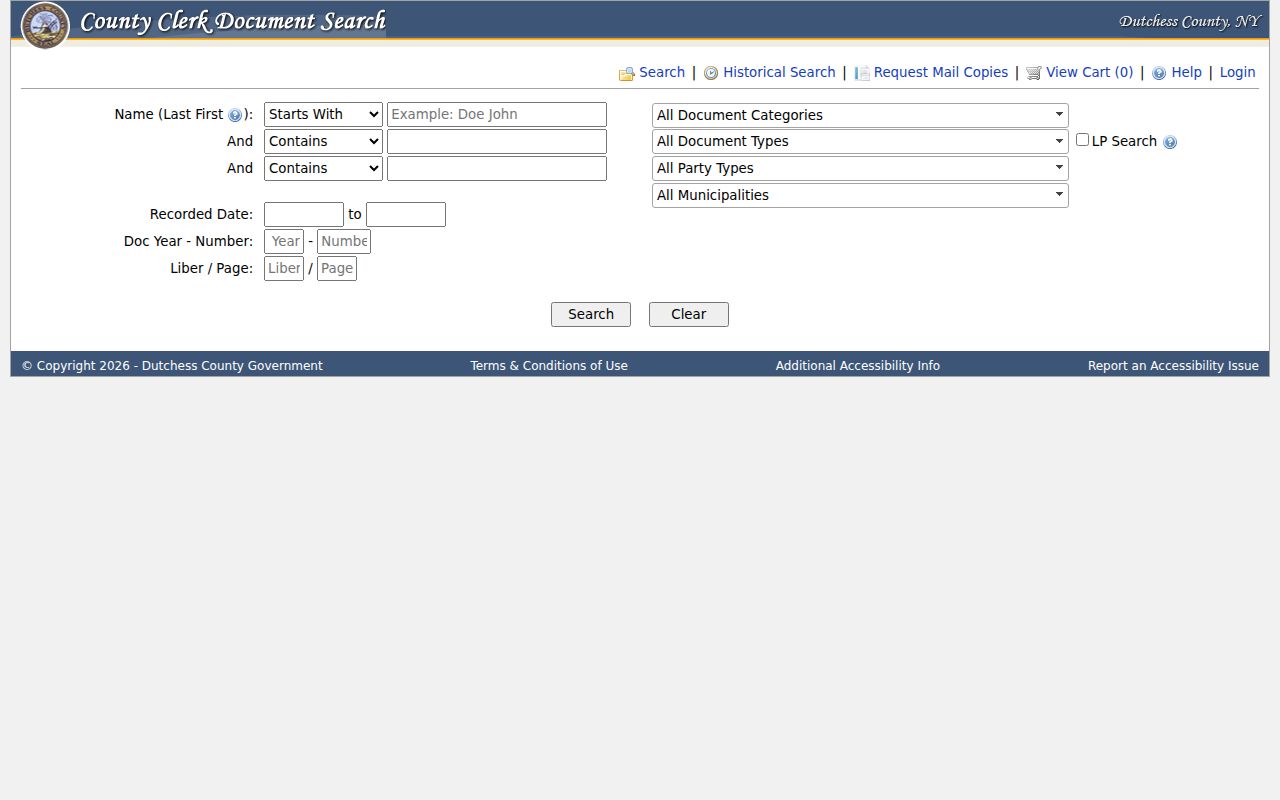
A search result supplies a trail to inspect. The deed image and the legal description decide whether it belongs to the address being traced.
- Grantor
- The party transferring an interest in the land in a recorded instrument.
- Grantee
- The party receiving that interest. Searching a later grantor as an earlier grantee often moves the chain back.
- Chain of title
- The sequence of recorded transfers connected through the same land description, not simply a list of similar names.
- Legal description
- The lot, subdivision, metes-and-bounds, acreage, or adjoining-land language that identifies land when a street number is absent.
Match Hyde Park Legal Records
A modern address can disappear as the trail moves back. Early Hyde Park deeds may describe a quarter-acre lot, a farm division, a road, a creek, an adjoining owner, or a landmark. Match the legal description to a filed map, parcel history, lot, acreage, and nearby Hyde Park owners. The County Clerk’s land records reach back to 1715, although the online deed path does not. A metes-and-bounds description uses directions and distances around a tract; it should be read as a land identifier, not converted casually into a present-day number.
Hyde Park’s historic vocabulary is also useful. A source may say Staatsburg, Stoutenburgh, Crum Elbow, Albany Post Road, or Market Street. Hyde Park separated from Clinton in 1821, and the earlier settlement naming history predates the modern postal system. Use those words as search terms, then compare the source’s date, land description, and place context.
Pair Hyde Park Household Records
Ownership is only one part of who lived here before. A dated Hyde Park directory can provide an address, telephone, or occupation entry. A census is periodic, but it adds a household view when an image and its coverage support the match. Begin with the oldest directory likely to include the relevant hamlet, copy the printed form and year, then compare it with the surrounding census years. A business, boarding, or post-office listing should remain labeled as such rather than assumed to be a home.
- Search the DCHS locator for the directory run closest to the address year, then note the title, publisher, shelf or request details, and any limitations shown by the catalog.
- Look for a street-side or criss-cross entry first. If none exists, search surname variants and preserve initials, widow notation, and abbreviations as printed.
- Pair the finding with a federal census year or an available New York state census. Check image coverage because some state schedules were lost or incomplete.
- Resolve a conflict with a third dated source, such as a deed, obituary, church record, or probate file. Record “listed at address in year” instead of making a broad residency claim.
The directory collections are described in more detail in the Hyde Park city directory collections. They remain a historical shelf, while this trail is tied to one address.
Dunbar Brown’s Hyde Park Record Method
The DCHS “Home of the Free” account provides a documented local model for prior-resident research. East Market Street lots were subdivided in 1826. Deborah and Dennis Beach bought a quarter-acre for $75, and Dunbar Brown bought two adjacent quarter-acre lots for $170 in 1834. A later 1857 instrument included Brown’s wife and sold two lots for $462. The article’s evidence-based inference is that a house stood there by 1857.
Those deeds should not be borrowed as proof about any other address. Their value is methodological: connect a person, lot, spouse, amount, date, and later instrument, then distinguish documentary fact from the historical inference it supports. That is a careful Hyde Park way to build an address history without inventing an uninterrupted household story.
Hyde Park Maps and Permit Records
Sanborn sheets can add physical context when an address trail reaches the early twentieth century. The Library of Congress collection includes unincorporated Hyde Park in a 1913 set republished in 1950 and 1952, with 100 sheets and 120 skeleton maps. A sheet may help date a building footprint, story count, construction material, use, or block arrangement. It does not identify an occupant.
For later Hyde Park work, Building and Zoning supplies applications and forms, but no searchable online permit archive was located. Ask for a narrow address and date range, or use the Town FOIL route for a public file. A request can name desired permit number, applicant, owner, inspection, and certificate fields while allowing exempt portions to be segregated. The lack of an online index does not establish that no file survives.
Note: A map or permit can date a physical change, while a directory or census can date a household clue; neither record type replaces the other.
Hyde Park Previous Resident Gaps
A missing entry does not prove that nobody lived at an address. Directory publication was irregular, and a Poughkeepsie or Dutchess County volume may have incomplete Hyde Park coverage. Telephone books are not a household census. Some census schedules are missing or incomplete. A street address may also be a later label placed on land that older sources identify only by road, hamlet, lot, or adjoining owner.
Keep the negative result with its exact source, date, and search form. Then try a surname variant, a historic locality term, the legal description, or the adjacent directory year. That record of what was checked is more useful than treating an absent name as a fact about previous residents.
Past Hyde Park Household Records
Close a Hyde Park address trail with records that place a family in time rather than extending a surname without evidence. DCHS lists obituary and death resources, marriage notices, church records, and Dutchess probate publications. The Reformed Dutch Church Hyde Park record set covers 1810–1899. The historical probate publication covers 1752–1865, while later estate files use the Dutchess Surrogate’s Court route. An obituary may supply relatives or place context; a probate file may name an executor, beneficiary, or property reference.
Past residents can also be checked against town minutes and historical publications. DCHS holds Records of the Town of Hyde Park, Dutchess County, New York, edited by Franklin D. Roosevelt in 1928, and Records of Crum Elbow Precinct, Dutchess County. These sources can explain historic names and actions, but they are not household rolls.
Lawful use. Research on previous residents is appropriate for house history, family history, estate questions, and personal curiosity. Do not use dated address records to track, harass, or harm a living person.